This article is help with choosing and keeping a rug, not medical advice. For allergy, fall-risk or infant-care decisions, the organisations cited below publish proper guidance and your clinician knows your case.
Why a rug page is quoting health bodies at all
Because three of the claims washable-rug marketing leans on are health claims in disguise: that a washable rug is better for allergies, that a non-slip backing makes a rug safe, and that a soft floor is good for babies. Each of those is checkable against a national body that publishes actual guidance. We read the three pages below before writing ours, and where the guidance cuts against us, we quote it anyway.
Allergens: what AAFA actually recommends
The Asthma and Allergy Foundation of America, in its guide to controlling indoor allergens, is blunter about carpet than any rug seller would like: bare floors are best, especially in the bedroom, and wall-to-wall carpet is to be avoided where possible. Eight out of ten people in the United States are exposed to dust mites, and soft surfaces are where they live.
The interesting part for this catalogue is the sentence that follows. For homes keeping carpet anyway, AAFA's advice is to use low-pile carpets or throw rugs you can wash. That sentence describes this product category exactly: a quarter-inch pile with nowhere deep for mites to colonise, on a rug that goes through a hot machine instead of hosting years of what a vacuum cannot reach.
So the honest allergy pitch is not that a rug helps. It is that if a floor is getting a rug anyway, the washable low-pile kind is the version the allergy people can live with. Source: Asthma and Allergy Foundation of America, How Can I Control Indoor Allergens and Improve Indoor Air Quality?, read 2026-08-06.
Slips and falls: the NIA guidance, quoted without softening
The National Institute on Aging's room-by-room fall-prevention guide has two instructions about rugs. First: check that all carpets are fixed firmly to the floor so they will not slip, and put no-slip strips on smooth floors. Second, and this is the one a rug catalogue is tempted to skip: for older adults it advises against throw rugs and small area rugs outright.
We are not going to argue with the second sentence, because the first one is the reason our construction exists. A rug that moves underfoot is a hazard; the rubberised non-slip backing on every design here, which our reviewers repeatedly confirm holds on wood and tile, exists to keep the rug where it was laid. Owners with robot vacuums report the rug staying put through cleaning passes, which is a decent everyday test of grip.
But if you are furnishing for an older household, follow NIA rather than a product page: prefer the larger formats anchored under furniture, which cannot travel, skip the small loose mats entirely, and keep every edge flat. A curled corner is a trip hazard whatever the backing is doing. If a small rug must exist near a door, tape the edges or accept the institute's advice and leave that floor bare. Source: National Institute on Aging, Preventing Falls at Home: Room by Room, read 2026-08-06.
Babies on the floor: what the AAP says about tummy time
The American Academy of Pediatrics, on its HealthyChildren page about back to sleep and tummy to play, recommends short awake sessions on the tummy from the start: two to three times a day for three to five minutes, building toward fifteen to thirty minutes daily by around seven weeks. The setting it describes is the floor, with toys placed in a circle around the baby, and its rule is the one that matters most: tummy time is for babies who are awake and being watched.
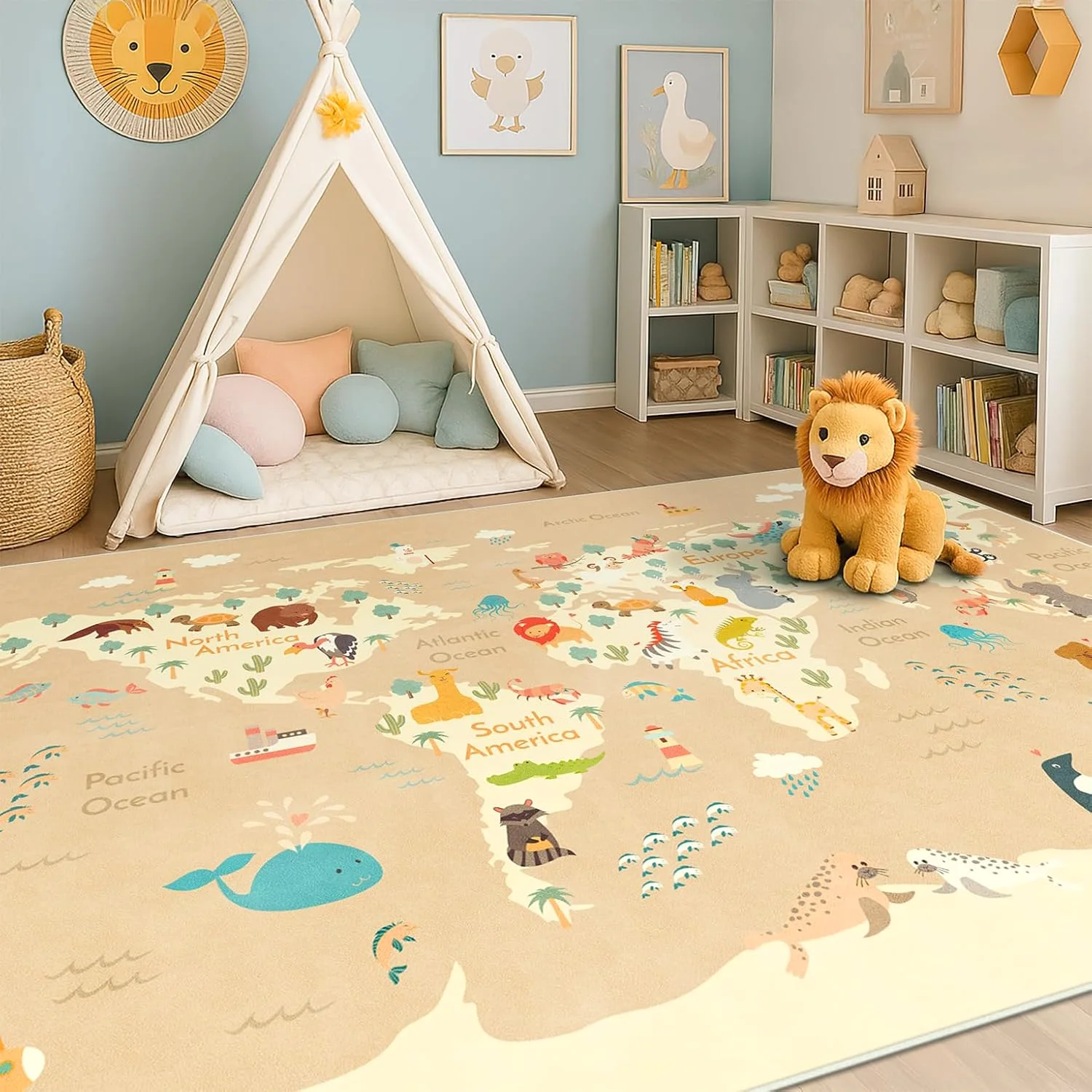
A firm, clean, low-pile surface is a reasonable stage for exactly that. The kids shelf is built as that stage: the print gives a crawler something to look at, the quarter-inch pile keeps the surface firm the way floor play wants, the backing keeps the stage from sliding mid-session, and the machine handles what babies do to surfaces. What the rug does not change is the supervision rule, so we will repeat it instead: awake, and watched. Source: American Academy of Pediatrics, Back to Sleep, Tummy to Play (HealthyChildren.org), read 2026-08-06.
The washing routine that makes the difference
All three pages above share one assumption: a floor covering is only as healthy as its cleaning routine. A washable rug's advantage is that its routine is achievable. The full method lives in the washing guide; the health-minded summary is:
- Vacuum the rug on the same schedule as the floor around it, weekly in living spaces.
- Machine wash on a regular cadence for rugs children play on, and after any spill that soaks in rather than sits.
- Dry fully before relaying. A damp rug on a hard floor is its own problem.
- Relay flat, edges down. The safest rug is the one lying exactly where and how it was placed.
What we are not claiming
No rug treats asthma, prevents a fall or develops a baby. The claims this catalogue makes are narrower and checkable: the pile is low, the backing grips, the machine takes it. The three organisations above set the context those facts live in, and their pages were opened and read on the date printed beside each citation, before a word of ours was written around them. The rest of the HazoHaus catalogue is written to the same rule, and the way we keep prices and figures honest is set out on the methods page.
Sources opened and read on 2026-08-06: Asthma and Allergy Foundation of America, How Can I Control Indoor Allergens and Improve Indoor Air Quality?; National Institute on Aging, Preventing Falls at Home: Room by Room; American Academy of Pediatrics, Back to Sleep, Tummy to Play (HealthyChildren.org).